About Me

My photo
Former teacher, clinical social worker and now entrepreneur. My focus, no matter what career I am engaged in, has been on helping people. Now I am on an incredible journey to change life in a leaner, cleaner, greener way. I hope you will join me in this transition.
Showing posts with label diabetes. Show all posts

Thursday, March 7, 2013

EFT (tapping) To Raise Your Metabolism - Try It, You'll Like It

I have recently started using EFT ("tapping") techniques and have had amazing results (more about that later in this post!!) I found this tapping sequence on "raising your metabolism" on YouTube. I decided to give it a shot and I could feel the difference immediately.  This was not just in my head.  My husband did this sequence with me and he had the same sensation after we completed the rounds!!

At first you don't really have to understand "why" this works ... just follow along with the tapper ... be sure to note how you feel before and after you do the "rounds."

Here is the video:


I know this is going to look and feel stupid (at least that is what I thought at first), but do it anyway ... here is my testimony after my first tapping experience.

Due to my diabetes I have had nerve damage to my toes.  It had become so severe that I couldn't sleep at night due to the "pins & needles" sensations.  I would have to take a scalding hot bath each night to overwhelm those nerves so I could sleep.  My husband talked me into trying EFT for the problem with my toes ... skeptically I agreed.  I did 3 rounds of tapping where the beginning pain was at a "10" and when I finished it was at a "1."  (This process took less than 5 minutes).  That was the first night I went to sleep without pain.  The next night the pain was back, but just in my big toe.  I did one more round of tapping and the pain went away and has not returned, even though it has been over three weeks.

I am not really sure why it worked ... but it did!!!  I hope you have this kind of success with your tapping experience.

Sunday, September 16, 2012

Confused About Portion Sizes? I Was!!

During my "Welcome to Diabetes Survival Class" (that's what I called it anyway), the instructors talked a lot about "portion sizes."  When I compared the sizes of the food portions I was actually eating to the pictures of the proper portion sizes, it turns out that I was misjudging the size of my portions by quite a bit (erring usually on the side of "too much" rather than "too little.") I think this is a natural consequence of eating in restaurants!!  The portion sizes you get on your plate are usually double the portion size you SHOULD be eating.

This article by Jane Kirby, RD and The American Dietetic Association can be found on Dummies.com, and it gave me a handy guide for determining the size of the portion I should be eating.  The bonus is that I can usually get two dinners for the price of one at most restaurants!!!

-------------------------------------------------------------------------------------------------------

When considering your nutritional needs, the amount you eat is as important as what you eat. Because people have diets filled with restaurant and convenience store foods, it’s difficult to remember how large a serving should be.
Portions of takeout food are much larger than the standard portion sizes defined in the Food Guide Pyramid. Even cookbooks are instructing people to serve larger portions. For example, the 1964 edition of The Joy of Cooking recommends cutting a 13-x-9-inch pan of brownies into 30 bars; the 1997 version is cut into 16 bars.
The following table lists the sizes of many foods that constitute one serving.

What Counts as a Serving:


Bread, Cereal, Rice, and Pasta: 1 slice of bread; half a hamburger bun or English muffin; 1 small roll, biscuit, or muffin; 5 to 6 small or 3 to 4 large crackers; 1/2 cup cooked cereal, rice, or pasta; 1 ounce ready-to-eat cereal.

Fruit:   One whole fruit, such as a medium apple, banana, or orange; half a grapefruit; a melon wedge; 3/4 cup fruit juice; 1/2 cup berries; 1/2 cup chopped fresh, cooked, or canned fruit; 1/4 cup dried fruit.
Vegetable: 1/2 cup cooked vegetables; 1/2 cup chopped raw vegetables; 1 cup leafy raw vegetables, such as lettuce or spinach; 1/2 cup cooked beans, peas, or other legumes*; 3/4 cup vegetable juice.

Milk, Yogurt, and Cheese: 1 cup milk, 8 ounces yogurt, 11/2 ounces natural cheese, 2 ounces processed cheese.

Meat, Poultry, Fish, Dry Beans, Eggs, and Nuts:   Amounts should total 2 to 3 servings (for a total of 5 to 7 ounces) of cooked lean meat, poultry without skin, or fish per day. Count 1 egg; 1/2 cup cooked beans, peas, or other legumes*; or 2 tablespoons peanut butter as 1 ounce of meat.

Fats, Oils, and Sweets: Use sparingly.

* Note that you can count dry beans, peas, and other legumes as a serving of vegetables or a serving of meat, but the same bowl of beans can’t count as a serving from both groups.

A half-ounce of peanuts. An ounce of cheese. Two cups of popcorn. A quarter cup of sunflower seeds. A teaspoon of butter. A 3-ounce chicken breast. These are foods that you’re apt to run into when you’re eating on the run. After all, no one goes to a restaurant or movie theatre packing measuring spoons or cups. So how are you going to know what a serving of these foods look like?
A deck of cards is about the size of a 3-ounce chicken breast, but if the cards you play are on your computer screen, you may not recognize what a portion looks like. But you take something with you wherever you go that can help you with portion size — the palm of your hand. That is, if you’re an average female. Gentlemen, hold your honey’s hand more often to get a sense of size. Better still, make sure to take her to restaurants and movies with you. Some other “handy” measurements are shown here.

You can use your hand to judge portions sizes.

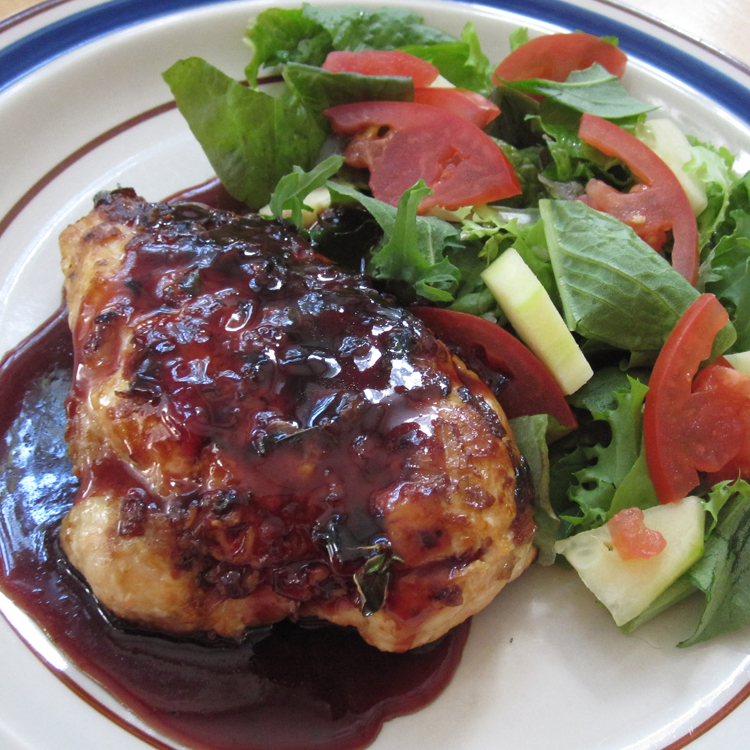
Herbed Chicken w/Raspberry Balsamic Sauce (Recipe)

I served this for company dinner last night ... and it was a major "hit" with everyone.  I didn't tell them how easy this was to make or that it was only 230 calories. The prep took me about 5 minutes, and it took the chicken about 20 minutes to cook up to the proper temp!!  This is a perfect recipe for a summer dinner.

Herbed Chicken with Raspberry Balsamic Sauce


1       teaspoon       olive oil
1/2    cup               red onions, chopped
1       Tablespoon  garlic, minced
1       pinch            red pepper flakes
1/2    teaspoon      dried thyme OR 1-1/2 tsp fresh thyme
1/2    teaspoon      salt, divided
4      (4-6oz)         boneless skinless chicken breasts
1/3   cup               seedless raspberry preserves (I used low sugar raspberry preserves)
2      Tablespoons Balsamic vinegar
1/4   teaspoon      black pepper

1.  Heat oil in a large nonstick skillet over medium high heat, add onion and garlic and saute 5 minutes.

2.  Sprinkle thyme and 1/4 teaspoon of salt over chicken.

3.  Add chicken to the skillet; saute 6 minutres on each side (or until internal temperature reaches 170 degrees).

4.  Remove chicken from skillet and keep warm.

5.  Reduce heat to medium, add 1/4 teaspoon salt, preserves, vinegar, and pepper to skillet, stirring until the preserves melt.

6.  To Serve:  Spoon sauce over chicken and serve immediately Or return chicken to pan and coat chicken evenly, serve immediately.

Nutritional Information:  (1 serving = 1 chicken breast with sauce)
Calories:  229.1         
Total Fat: 4.1g (Sat. Fat 0.8g)         
Cholesterol:  72.5         
Sodium:  433.5mg
Total Carbohydrates:  21.7g (Dietary Fiber 0.7g, Sugars 14.9g)         
Protein: 24.4g

Notes
             1.  If you want a thicker sauce, let it cool slightly before pouring it over the chicken.            
             2.  I am going to try this with other no-sugar preserves to see how it works:  apricot, blackberry, peach.
             3.  This recipe is also diabetic friendly..
            

Friday, September 14, 2012

Benefits of Walking

After reading this article I decided, even with my bad knees, that I need to start walking more.  I am soon going to have a great looking body and I want to have the time to enjoy it ... so grab your pedometer and join me!!!

Benefits of Walking -- http://health.yahoo.net/experts/dayinhealth/easiest-way-live-longer
Did you know that every minute you walk can extend your life by 1.5 to 2 minutes? In addition, many studies show that people who walk regularly live longer, weigh less, have lower blood pressure, and enjoy better overall health than non-walkers.
Ready to lace on your shoes? If you want to add to the amount of walking you do, just clip on a pedometer. That simple action actually increases your physical activity by over 2100 steps per day, a review that pooled data from 26 studies found.
Here’s a look at ten benefits of walking.
Walking Increases Your Lifespan
Walking more than an hour a day improves life expectancy significantly, a 2011 study showed. The researchers looked at 27,738 participants between the ages of 40 and 79 over a 13-year period. Surprisingly, their lifetime medical costs did not increase—even though they lived longer.
“An increase in walking time at the population level would bring about a tremendous change in people’s health and medical cost,” the study authors wrote.
Walking Wards Off Diabetes
Just thirty minutes of walking a day can prevent diseases such as type 2 diabetes, a 2002 study looking at both overweight and average weight men and women in a population at high risk for the disease showed.
If you already have diabetes, walking is helpful for you, too. A mile or more daily cuts your risk of death from all causes in half, according to a 2007 study.
Walking Keeps Your Mind Sharp
Walking 72 blocks a week (around six to nine miles) helps increase grey matter, which in turn lowers the risk of suffering from cognitive impairment—or trouble with concentration, memory and thought, according to a study which looked at 299 seniors over a nine-year period.
Furthermore, walking five miles per week can provide some protection to the memory and learning areas of the brains of those already suffering from Alzheimer’s disease or mild cognitive impairment, and lead to a slower decline in memory loss.
Walking Helps Lower Blood Pressure
Walking just 30 minutes a day, three to five days a week—even when the 30 minutes are broken into three ten-minute increments—has been found to significantly lower blood pressure.
 Walking is Great for Bone Health
Putting one foot in front of the other for about a mile a day led to improved bone density in post-menopausal women, and slowed the rate of bone loss from the legs, according to a 1994 study. “It takes walkers four to seven years longer to reach the point of very low bone density, study leader Dr. Krall told the New York Times.
Walking Cuts the Risk of Stroke
Walking about 12.5 miles a week or more cut the risk of stroke in half, according to a study looking at over 11,000 Harvard University alumni with an average age of 58.
Walking Improves Your Mood
If you’re feeling down in the dumps, walking is a quick and easy solution. Just thirty minutes on a treadmill reduces feelings of tension and depression, according to research published in the British Journal of Sports Medicine. In fact, the study found that walking lifted moods more quickly than anti-depressants did (and with fewer side effects).
And the more people walk, the better their mood and energy, says California State University Long Beach professor Robert Thayer, based on a study looking at 37 study participants over a 20-day period.
Walking Torches Calories
Just 20 minutes of walking a day will burn 7 pounds a year. The effects are even more dramatic when you add in some dietary changes as well.
Walking Improves Insomnia
Having trouble sleeping at night? Try taking a brisk 45-minute walk in the morning five days a week, and your sleep may improve significantly, according to research from the Fred Hutchinson Cancer Research Center in Seattle, which looked at women from the age of 50-74. (Walking in the evening, however, sometimes has the opposite effect—so keep an eye on when you’re exercising and what your sleep patterns are.)
Walking is Good for the Heart
Women who took brisk walks for three or more hours per week reduced their risk of heart disease by 30-40 percent, according to an analysis of over 72,000 women aged 40-65, who were enrolled in the prospective Nurses’ Health Study. As I reported recently, heart attacks kill more US women than men annually. However, the benefits of walking aren’t limited to one gender. A different study showed that walking can cut the risk of coronary heart disease in half for men between the ages of 71 and 93.